


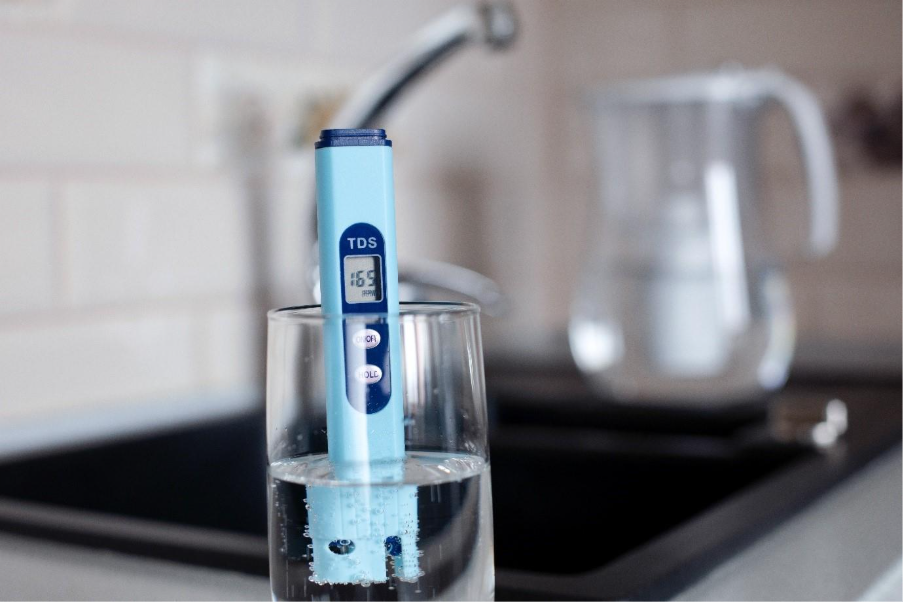
In the Water Treatment industry, TDS (or total dissolved solids), refers to the amount of organic and inorganic substances that are found in the water. These are mainly made up of dissolved minerals and salts. For example, calcium and magnesium.
Organic substances are also found in water, though at a lesser level. This would include natural organic mater from soil and decaying vegetation, (humic acids and fulvic acids). Run off from agriculture would be another example so pesticides and fertilizers for example.
These organic substances are more likely to cause health risks than essential mineral salts (inorganic compounds).
How do I measure TDS?
This is measured in parts per million (ppm) through the use of a small TDS meter. This easy-to-use handheld device works within seconds and gives you a reading of the total dissolved solids in ppm (parts per million).
How to measure TDS at home
- Get a clean glass of water and your TDS Meter. (They are in-expensive to buy, often retailing for £7-15 online).
- Switch on the meter, then remove the cap.
- Dip the probe into your water (ensuring the water is not running water and the sensor end is dipped in).
- Give a gentle stir to get rid of air bubbles.
- Wait for the reading on your screen to stabilise.
- Read your result and note this down (recorded in ppm).
Note: TDS is simply a measure of dissolve solids and not a health risk indicator. It could mean high calcium or sodium, but not necessarily “toxic”. It does not tell you what the substances are.
| TDS Level | Drinking water suitability |
| 0-50 | RO water or distilled usually. Not ideal – lacking in minerals |
| 50-150 | Optimal |
| 150-300 | Good |
| 300-500 | Can be noticeably “hard” but considered okay for drinking |
| 500-1000 | Not recommended for long-term. Can indicate high level of contaminant or minerals, though not necessarily toxic. |
| 1000 | Not recommended. Highly recommended to get water tested for specific contaminants to see what is causing the high reading. |
- (1ppm = 1mg/L.)
What is the industrial importance of TDS Monitoring?
A high level of TDS can cause damage to equipment and make it less efficient. For example, the build up of scale in boilers and heat exchangers making heat transfer less efficient and thereby increasing energy consumption. Power plants and manufacturing rely on good TDS control, but they are not the only ones that make use of this…
In the food and beverage industry, TDS is monitored to ensure there is a consistency in the product and the taste.
Not forgetting, the pharmaceutical manufacturing industry will need high-purity water, so they need to ensure their TDS level is met for drugs and the complying with the industry regulations.
What’s the difference between TDS and water hardness?
Simply put, the TDS will measure the level of all organic and inorganic substances in the water while the hardness will focus only on how much calcium and magnesium there is. The latter is responsible of the build-up of scale.
RO vs Ion Exchange: Which is better for reducing TDS?
On the whole, Reverse Osmosis, or RO as it’s more commonly referred to, is better for reducing levels of TDS. You can expect it to remove between 90-95% of dissolved solids on average. It is commonly used in the purifying of Drinking Water in domestic situations such as purifying water for use in a household’s kitchen.
Meanwhile, ion exchange resins can be very good at targeting specific ions to remove such as magnesium (ion exchange can be great then for softening water).
How should I maintain TDS for drinking water?
You can purchase a TDS meter online and expect to pay between just £7-15 for a basic handheld device. A reading of below 50 lacks essential minerals so water can be flat-tasting and not as preferable as the 50-300 range. It can have a rather empty/bland sensation to it. Ideally, for the best taste and health, 150-300ppm is a very good level. Anything above 500 may have less desirable taste such as metallic so is less ideal.
If your TDS is too high, you may want to consider using Reverse Osmosis in the form of an RO purifier as this can reduce TDS between 90-95%. You can even incorporate a post-filter to add essential minerals back into the water.