


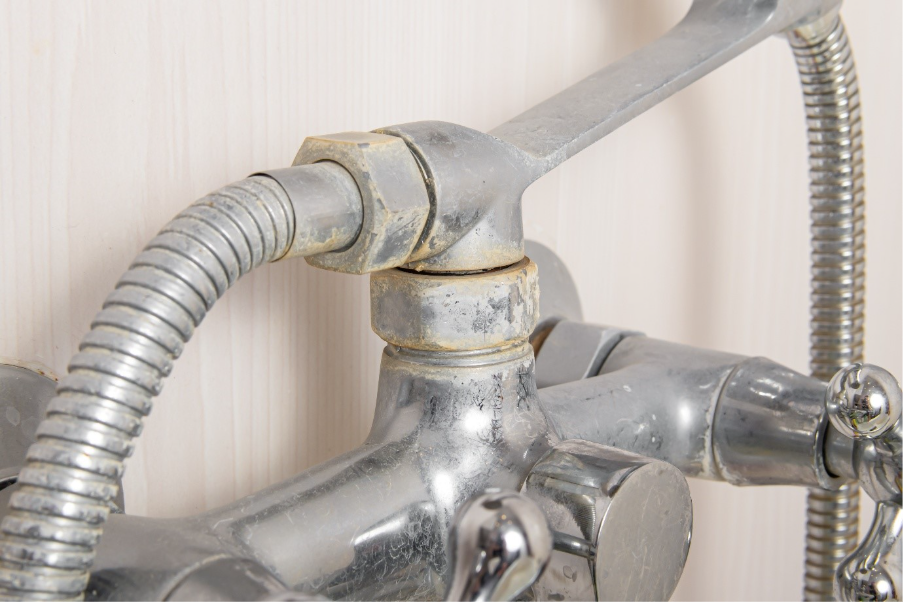
Hard water can wreak havoc in your house if left untreated. Across the UK, it causes many problems such as the buildup of unsightly limescale, boilers breaking down and more cleaning. It isn’t just what you can see though… There’s the hidden costs of your gas and electricity bills being higher than they need to be.
These issues occur because of the make-up of Hard Water. When rainwater passes through rock such as limestone or chalk, it will collect the hardness minerals calcium and magnesium. These will go into the local water supply before entering your home.
Hard water areas in the UK
You will be exposed to soft or hard water depending on what part of the UK you live in (or medium level of hardness in some places). This can be defined as soft being under 100ppm (parts per million) whereas hard would be over 200ppm. At the top end, we see our capital London have hard levels, along with both the East Anglia & Midlands regions. At slightly less, we have areas that are more moderate in some of the Midlands and Lincolnshire area.
Meanwhile, the majority of Scotland is known for having much softer water. Wales also features areas of softer water along with major cities like Manchester and Liverpool. As a general rule of thumb, if you’re living in the South East areas of the UK, you’re likely to have hard water whereas if you reside in the North West, you’re more likely to have hard water flowing through your home.
The table below is a good guideline for water hardness.
| PPM – Parts per million | Water hardness |
| 0 – 50 PPM | Soft water |
| 51 – 100 PPM | Fairly soft |
| 101 – 150 PPM | Slightly hard |
| 151 -200 PPM | Fairly hard |
| 201 – 275 PPM | Hard |
| 276 – 350 PPM | Very hard |
| 350+ PPM | Aggressively hard |
Of course, you don’t have to just put up with a Hard Water Problem though. Protecting your house from hard water is both economically savvy and wise to help you with spending less time cleaning.
Hard Water Solutions
Investing in a water softener for your home can help treat the water that you use for your entire home by removing the hardness causing minerals (calcium and magnesium). It safely replaces with sodium ions instead.
It works by water passing through a bed of resin which in this case, we use water softening resin of course. These polymer beads are used for a process called ion exchange resin, where the ions are replaced with less harmful ions (sodium). The water that exits the system is now soft.
You can find this type of water softening resin (CG8) in the ion exchange resin category on the Resin Products site.
Although there is the initial cost of the water softening system itself, they are cheap to maintain, requiring just water softening salt bags for maintenance. These are typically purchased on a monthly basis – usually around £10 per bag.
Using water softening resin within a water softener is really the go to solution for these issues. It is not to be confused with an RO (reverse osmosis) system though, which instead have a different purpose. (Removing all the contaminants, but not actually softening the water). This will not address the limescale issues in your home.
Hard Water Solution Benefits
If you decide to invest in domestic water softening system, you can look forward to
- Less visible, unsightly limescale on taps, sinks and shower.
- Longer lasting appliances such as dishwasher and machine machines, usually worn down by the accumulation of limescale.
- More efficient appliances as scale gets reduced, so your energy bills are not needlessly rising.
Benefits of soft water for skin
If you suffer with sensitive skin, then you may find your skin becomes less irritated when you have soft water for your showers. This is because the hard water can disrupt your skin natural protective layer of oils, leaving you with irritated and tight feeling skin.
Check Water Hardness
Unsure about your levels? You can check your water hardness from your postcode by inputting this data online. Of course, if you notice symptoms such as limescale on taps and sinks, then don’t delay in getting your home treated.
To learn more about the costs of running a water softener, you can check out our past blog which outlines the key costs you need to know. Finally, don’t forget, you can order water softening resin via the Resin Products website by asking for CG8 resin when submitting to enquiries@resin-products.com.
FAQ
Do I have hard water?
Look out for limescale build up in your home and spots on your glasses as telltale signs. You can also check your postcode online to see if you fall under a hard water area.
Is hard water bad?
It isn’t bad for your health for drinking purposes (quite the opposite). It actually contains essential minerals you need. However, for your home appliances and limescale built up on taps etc, it is not good and causes a lot of household problems. It can also dry out your skin and hair.
Is hard water common?
It is! It’s estimated half of the UK has hard water in their homes.
How can I stop hard water?
You should strongly consider a water softener for your home. It will ensure the water you then use is soft.
What areas have the hardest water in the UK?
This would be the capital, London and areas that are South-East of England like Essex.