


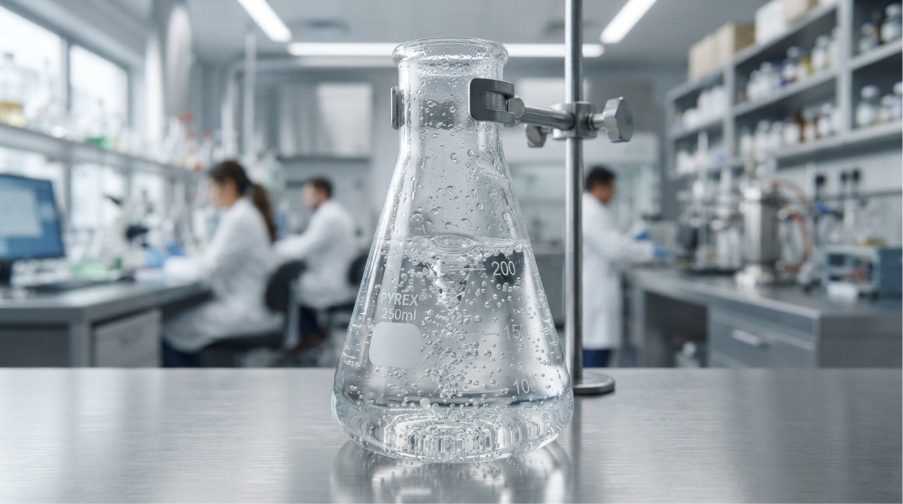
Water purity is critical in the lab. Contaminants and impurities can ruin analytical results, and the water used in this environment will need to be suitable for diluting samples, cleaning sensitive equipment, testing within microbiology, and other procedures requiring strict control.
We’ll look at the three types of purity levels for the water produced from this filtration. Within an ultrapure water system’s lab set-up, you will need high-purity deionisation cartridges to achieve Type I water. Further into this blog, we will then provide examples of laboratory Water Filter Cartridges you can use from Resin Products.
How do lab cartridges work?
We know that in the UK and across the world, lab water purification is responsible for making sure university research, clinical diagnostics and biotechnology can all run smoothly. So, how does it work?
Let’s look at the IX series high-capacity, colour-changing DI cartridge and how this achieves contaminant-free water in three simple steps.
1. Entering the cartridge
Firstly, water enters the polycarbonate tube under pressure. At this moment, the water will still contain dissolved minerals such as calcium or chloride. Within the cartridge, very small beads of specialised resin have specific chemical ionic changes built into them. These beads are split into a mix of cation (positively charged) and anion (negatively charged) resins.
2. Inside the cartridge
This is where ion exchange takes place. Positive ions like sodium and calcium are trapped by the cation beads which then release hydrogen ions (a trade-off we call ion exchange). The negative ions like chloride and sulphate get trapped by the anion beads and release hydroxyl ions.
As we are looking at the colour changing cartridge here, it’s important to note the following: when these resins become exhausted, they lose their capacity to exchange ions and thus, change colour. This gives a visual indicator that the cartridge needs to be replaced as the media is now spent.
2. Exiting the cartridge
These hydroxyl pairs and the released hydrogen bond together and the end result is the formation of pure water, which then flows out of the cartridge. This is now completely demineralised.
Lab water quality standards
Type I
There are international standards for each level/standard. These can be split into three types or grades. For example, Type I can define as ultrapure water (the highest of the three categories here). This has a resistivity of 18.2 MΩ·cm (at 25°C). This is reserved for extremely sensitive analytical tests like PCR (Polymerase Chain Reaction).
Type II
Secondly, we have Type II, which is regarded as pure water (the step below ultra purity). We can use this in buffer preparation and more generic tests in the laboratory.
Type III
Finally, the lowest grade here is Type III. This is known as RO (reverse osmosis) water. In the lab water purification sector, we can call this a primary grade. Typically, you can use this for glassware cleaning and in the preparation of non-critical solutions and buffers that don’t need sensitive analytical precision.
Types of lab filtration cartridges
To ensure your lab tests operate without chemical interference and keep your equipment properly protected, a level of pure/ultrapure water is required. These cartridges help deliver this.
The VP Series is excellent for a variety of applications depending on the cartridge. For example, the mixed bed deionisation cartridges are point of use and produce ultra-high purity, lab-grade water that can be used for analytical grade preparations.
Meanwhile, the IX series cartridges include the highest purity and highest capacity resin and are available as a colour changing DI resin. It is a universal equivalent and gives the user a handy built in visual indicator for when the media becomes exhausted. Inside is a mix of high purity anion and cation resins.
Aries RO/DI Feed Cartridge Kit
Resin Products can also provide the replacement kits needed for lab water purification systems. This feed cartridge kit is designed to be used with the CLiR 300 Series High Purity Water System.
Ultrapure Dual Conditioning Pack
This serves as a conditioning pack to pre-treat or polish feedwater. It makes use of ion exchange resin mix to take away trace ionic impurities and dissolved minerals before the water goes through final filtration.
Laboratory water purification UK
Do you run a lab in the UK and need your replacement lab filtration cartridges? Fill out our enquiry form, and we’d be happy to guide you on your water purification needs.
FAQ
What can my lab cartridge be used for?
It depends on the water purity type achieved, but common applications include sensitive equipment cleaning, general reagent preparation and preparing chemical buffers.
What are the grades of water I can achieve?
You can achieve Type I, Type II and Type III.
Which type gives me ultrapure water?
Type I.
How often do my lab cartridges need to be replaced?
It will depend on your usage, the quality of the water and the specific cartridge you are seeking to replace. In general, you can expect this to be around every 3-12 months.
Does Resin Products sell cartridges for Vaponic laboratory systems?
Yes, we provide replacement cartridges for this such as the VP series Activated Carbon Std.