


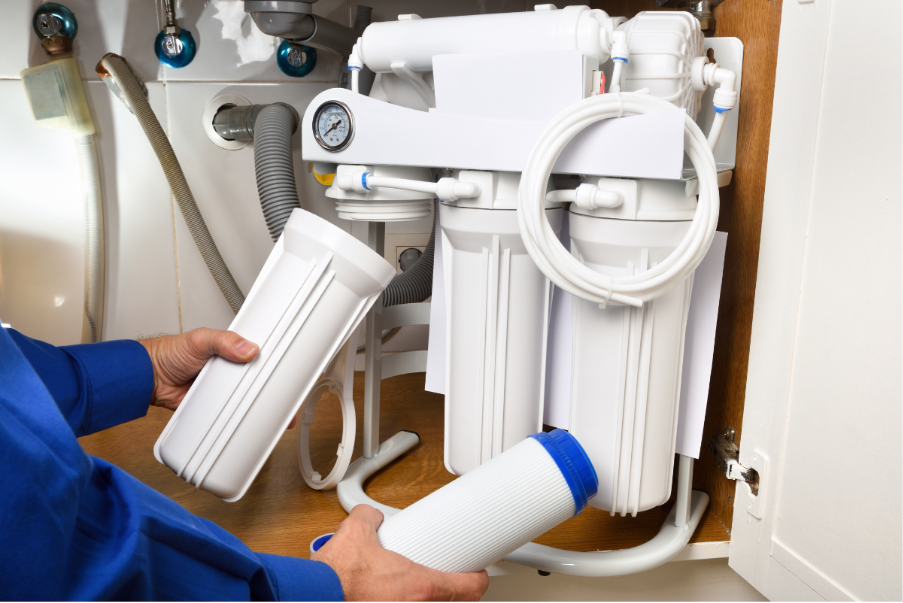
Activated Carbon Filtration
A very popular choice in domestic water treatment, Activated Carbon is highly sought after for its ability to transform residential drinking water. It utilises the adsorption process whereby contaminant molecules end up adhering to the surface area of the carbon.
This nifty water filtration media can capture VOC’s (volatile organic compounds), herbicides & pesticides, free chlorine, nitrates and more.
Benefits of Activated Carbon Filtration
You end up with better tasting water as chemicals and impurities become trapped, as well as eliminating bad odours from your water such as chlorine.
Many families decide on this type to enhance the taste of their daily tap water at home. This is also particularly beneficial to the beverage industry, who rely on drinking water to be consistently tasty and refreshing, getting rid of that chemical odour and taste.
You can pick up a cartridge through the Resin Products filter cartridges section. The ResinTech Premium Drinking Water Filter Cartridge fits regular residential and industrial size housing and is used for correcting taste and odour, managing scale and dechlorination.
Reverse Osmosis
This water filtration method filters the water at a microscopic level. It can be used at a domestic level or commercial/industrial too. The food and beverage industry benefit from this, but it’s not only them. Industries such as the pharmaceutical and medical rely on it for having water that must be completely sterile.
Benefits of an RO System
At home, you can look forward to the following benefits if you integrate one of these systems into your domestic water set up.
- Removal of up to 99% of TDS (total dissolved solids). This includes pesky contaminates such as fluoride, lead, chlorine and salts.
- The forever chemicals known as PFAS
- Bacteria and viruses
Ion Exchange Resin
These polymer beads have wide variety of application within water filtration. One of these being for water softening, but they are also uses for specific contaminant removals like Nitrate.
To soften water, the method works via the ion exchange process. This is when water flows through a bed of resin beads which have an electrical attraction to the unwanted ion. Calcium and magnesium ions get exchanged for the harmless sodium ions. The water that leaves the water softener is then free of hardness causing ions.
Benefits of Ion Exchange Resin (for water softening)
Now, the water is safe for pipes (lasting longer appliances too!) and softer for your skin and gentle on your hair too. You will also find less visible limescale around your kitchen and bath taps. The go to Ion Exchange resin for softening purposes is ResinTech CG8.
Sediment Filters
This one focuses on filtering out the solid pieces from the water. In short, any particle that is not a liquid within your water. It does this by allowing water to go through a porous medium (a solid material which has holes/pore.
Be aware, mechanical filter such as sediment filters will have a micron rating. This determines what particles they can remove. For example, a micron rating of 50 is used to remove things like grit, large sediment etc whereas 5 micron targets microscopic debris.
Benefits of Sediment Filters
Typically, it’s used in whole house pre-filters as well as well water well systems.
For your house, it will help your dishwasher, machines from getting the mechanical damage caused by grit. Meanwhile, for the purpose of well water, it’s the first stage of filtration and excels in preventing pesky dirty, sand, silt, clay and similar solid particles from entering more filtration stages.
It’s not just dishwashers and washing machines though. It will help go onto extend the lifespan of systems like water softeners and reverse osmosis membranes because of the clogs being prevented.
Ultraviolet (UV)
This type of Water Filtration is used for removing bacteria and viruses. By using light rays, the harmful viruses or bacteria are eliminated, minus the need for chemicals. It effectively renders the germ useless as the light disrupts their genetic code.
It’s important to note that sediment filtration has to go first before using Ultraviolet disinfection. This is due to the particles blocking the microorganisms from the UV light, which would make the method ineffective.
Benefits of Ultraviolet water filtration
The benefit of this type of filtration is to receive water free of bacteria and viruses.
For private water supplies like a well or a borehole, it’s used to make the water safe for drinking.
Another common use is in the food and beverage industry as water needed here needs to meet a very strict health regulation, without altering both taste and odour.
Which type of Water Filtration Do I need?
It will come down to what you want from your water. If you’re seeking a taste enhanced, odourless water, then your best option is either to use a reverse osmosis unit or the activated carbon filters.
Meanwhile, if you have water issues concerning hardwater such as scale build up, dry irritated skin, then ion exchange would be better.
It’s worth going through each water filtration benefits to determine what aligns with your water goals.
FAQ
What water filtration is good for my home?
For a point of use water filtration, an activated carbon filter is good for households looking to enhance their water taste and odour for their daily hydration needs.
Which is best for getting soft water in my home?
For getting soft water, ion exchange resin is your best option here (water softening resin).
Which water filter method is best for clean water?
Reverse Osmosis as it has an impressive 99% removal rate for most contaminants.
Where can I buy an activated carbon filter?
Resin Products stock the premium drinking water filter cartridge (manufactured by Aries) which uses activated carbon.
What does dechlorination mean?
This is the removal of chlorine or chloramines.